







Traditional and novel wooden jigsaw puzzles
The puzzlemakers craft
[Home] [Brief history] [Handcrafted puzzles today] [Making of auPuzzles]
"The role of the puzzle-maker is hard to define. In most cases - and in all cardboard jigsaws - the puzzles are machine made, and the lines of cutting are entirely arbitrary: a blanking dye, set up once and for all, cuts the sheets of cardboard along identical lines every time. But such jigsaws are eschewed by the true puzzle lover, not just because they are made of cardboard instead of wood, nor because the solutions are printed on the boxes they come in, but because this type of puzzle destroys the specific nature of jigsaw puzzles." |
'Life,
a Users's Manual' by Georges Perec, Collins Harvill, 1987 |
Brief history of jigsaw puzzles
It is not possible to say when jigsaw puzzles were invented, but they were commercialised by John Spilsbury in around 1760. Spilsbury was a mapmaker in London, who made the puzzles as educational aids. Early puzzles were hand cut and cost more than the average weekly earnings. By the mid 1800's jigsaw puzzles had become an entertainment. Advances in printing and cutting methods progressively reduced prices, culminating in the die-cut cardboard puzzles that are mass-produced today. These technological advances also reduced the individuality of puzzles and all but wiped-out the art of puzzle making.
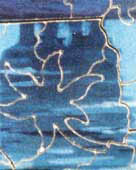 |
Early jigsaws were dissected into relatively simple shapes that did not interlock. These puzzles are sometimes called push-fit puzzles. They often featured colour-line cutting, false edges (internal straight edges) and silhouette pieces/whimsies. The puzzle on the left is a detail of a Parker Brothers' puzzle cut in 1931. It shows push fit pieces, a silhouette piece (tree), false edges (top) and colour-line cutting (top and right-hand side). |
Interlocking puzzles became more common from the mid 1900's. The shape of pieces in the best interlocking puzzles is complex, which adds an element of difficulty to the puzzle.
 |  |
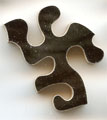
Standard piece from a 'strip cut' cardboard puzzle |
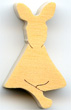
Elaborately shaped piece in a handcrafted puzzle, that adjoins 6 other pieces |

Handcrafted puzzles in the 21st century
The best jigsaw puzzles are still those that are handcrafted in wood using mechanical scroll saws (also called jigsaws) with exceptionally fine blades. These blades produce a much smoother cut than the burnt surface produced by laser cutters, or the blasted surface produced by water jets. Each piece is carefully sanded and finished to produce the beautiful feel always associated with well-crafted wood. Puzzlemakers still exist in many countries.
The handcrafting of wooden puzzles has survived as a skill because it produces the best puzzles, not because of sentimental attachment to an old technology. |
In each puzzle the puzzle maker uses his or her imagination and skills to entertain and challenge the puzzle assembler. Sometimes the puzzlemaker interacts with an unknown puzzler, but the relationship between maker and assembler can be more personal (see made to order jigsaws).
Slightly more down-market are wooden puzzles cut in simpler styles (e.g. 'strip cutting' - the pattern used in most cardboard puzzles), or several at a time in a stack, or using computer guided lasers or water jets. Computerised cutting templates result in identical puzzles and can be used for production runs from two to thousands of puzzles.
Cardboard puzzles are stamped out (die-cut) using a form with cutting edges arranged in the shape of puzzle pieces. Tens of thousands of identical puzzles are produced from a single die, and the same die is applied to many different images.
The making of auPuzzles
Our puzzles are cut with a scroll saw, using the skills traditionally practiced by makers of fine jigsaws. They are made from hoop pine, a species that is native to Australia and is plantation grown. The back of the puzzle is sanded.
Our cutting style is varied according to the needs of the buyer.
| In our unique jigsaws, the number of the jigsaw is written on the back of the signature puzzle piece. |  |
Push-fit jigsaws with complex shapes are possibly the most difficult puzzles, but they can be irritating because the jigsaw falls to pieces if bumped. We make some small push-fit (non interlocking) jigsaws and sometimes use the style in large jigsaws.
On both our unique and our small puzzles you will find other examples of the devices used by cutters to challenge puzzlers including false edges, false corners, non-interlocking edge pieces, colour-line cutting, irregular outlines, split-corners, dropouts, double-sided pieces and near-identical pieces. Click here to see some of these features.

'Jigsaw Puzzles, an Illustrated History', Anne D Williams, Wallace Homestead Book Company, Radnor, Pennsylvania (1990).
'British Jigsaw Puzzles of the 20th Century', Tom Tyler, Richard Dennis, Shepton Beauchamp, Somerset (1997).
